This is my first research experiment in image generation. I wanted to find out whether a small adapter could teach an open-weight text-to-image checkpoint to edit a source image from a natural-language instruction. The model had to follow the requested change while preserving everything else. Adding the right object while repainting the entire scene would not count as reliable editing.
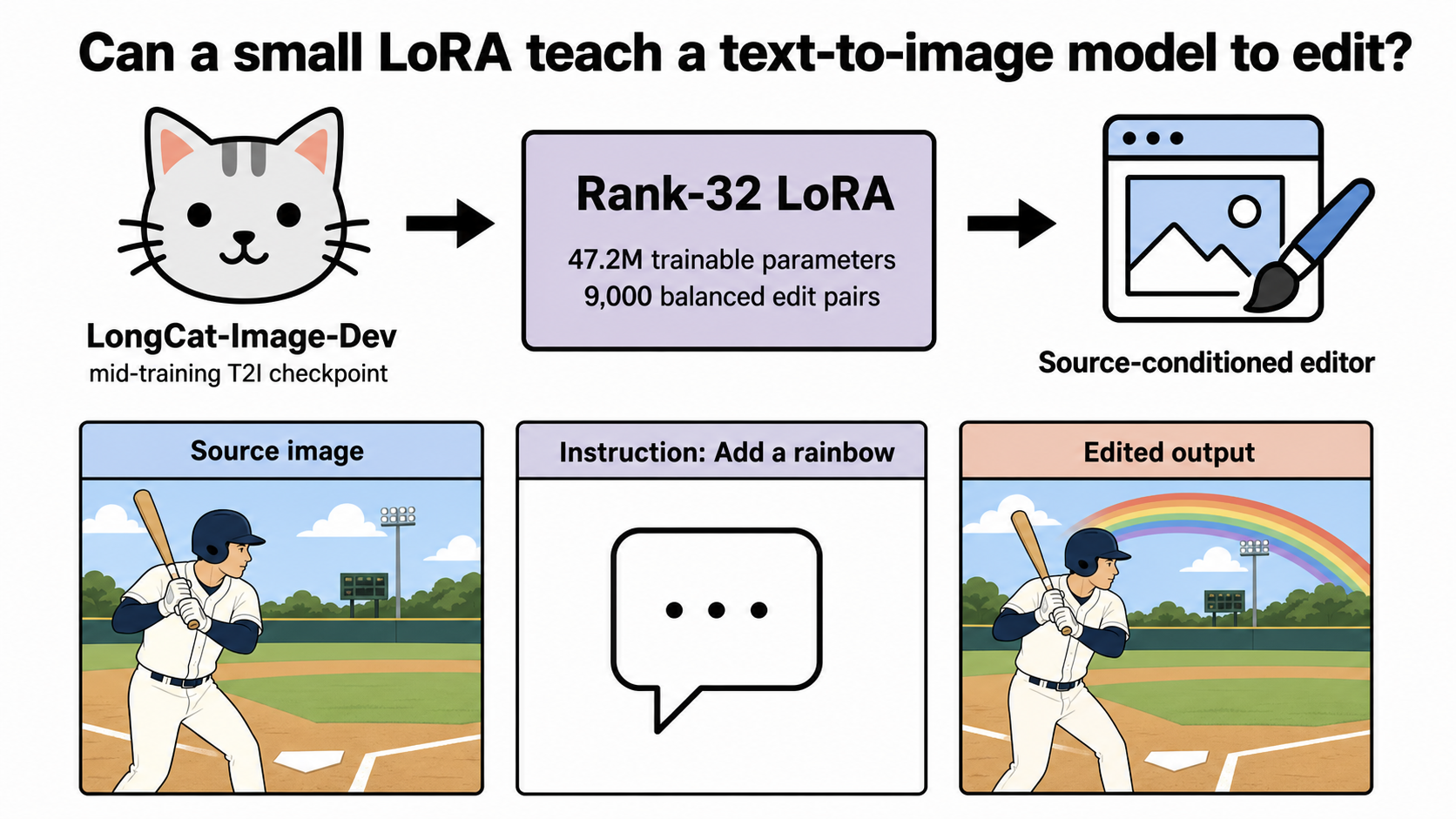
Figure 1. The bounded question behind the project: can a rank-32 LoRA teach source-conditioned editing to a mid-training text-to-image checkpoint?
Why I Picked LongCat-Image-Dev
I used LongCat-Image-Dev, a 6B-parameter development checkpoint released by the Meituan LongCat team in late 2025. Dev is a mid-training, comparatively plastic state intended for downstream SFT, LoRA, and specialized Edit training. Their technical report also initializes the full LongCat editor from the mid-training text-to-image model rather than its final post-trained checkpoint.
I was not reproducing the full LongCat-Image-Edit recipe. My experiment kept the official source-conditioning machinery, updated only a LoRA adapter, and asked what could be learned from 9,000 balanced edit pairs.
The Zero-Shot Gate
Before training, I constructed the Edit pipeline using only Dev components. With the source, seed, resolution, guidance, and sampling steps fixed, I asked it to replace a cat, add red sunglasses, and recolor a gray sofa. All three outputs reconstructed the original cat and sofa without meaningfully following the instructions.
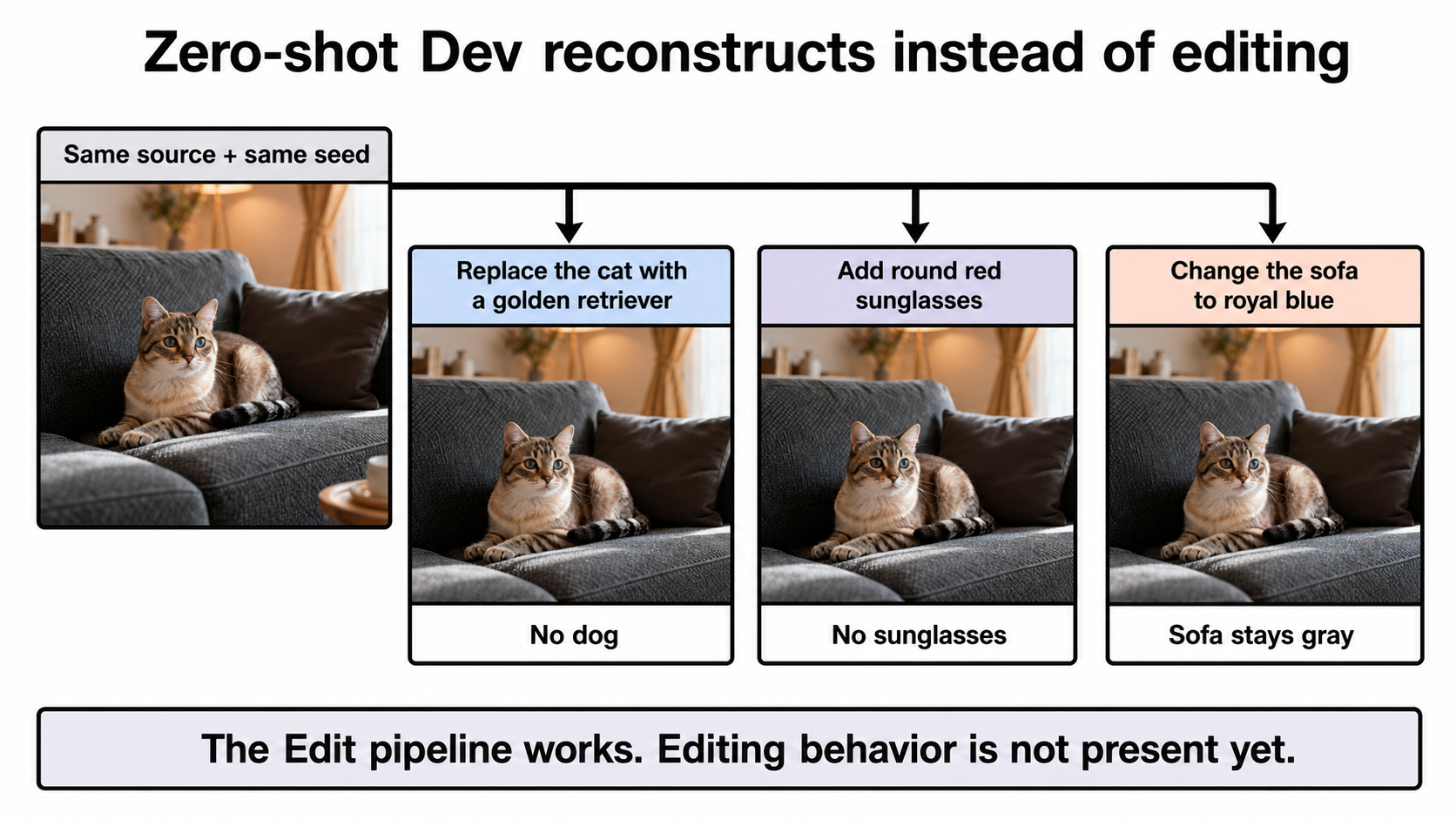
Figure 2. Architectural compatibility was not the same as editing ability. Dev accepted source-image conditioning, but editing behavior still had to be learned.
This was a useful failure. The source-conditioning pipeline executed end to end, but any later editing behavior would have to come from fine-tuning.
Training the Adapter
I used the UltraEdit portion of GPT-Image-Edit-1.5M, pinned to 100,008 validated source, target, and instruction triplets across nine edit categories. The serious baseline sampled 1,000 training pairs and 100 held-out pairs per category, then trained once over 9,000 examples at 512 pixels on an NVIDIA H100.
The recipe used a rank-32 LoRA on attention and feed-forward projections, BF16, a learning rate of 1e-4, 100 warmup steps, gradient checkpointing, and flow matching. Only 47,185,920 parameters were trainable. Noisy target latents were concatenated with source latents, and Qwen2.5-VL saw both the source image and instruction.
After an 18-example smoke test and a 2,250-example pilot, the 9K run completed in about 66 minutes, produced nine resumable checkpoints, and reloaded the final adapter successfully.
Editing Appeared, but So Did Global Regeneration
The adapter clearly learned something the base checkpoint did not have. Rainbows, balloons, recolors, snow, and requested objects began appearing. The important surprise was when they appeared: the checkpoint study showed broad scene changes by step 1,000, not only after prolonged training.
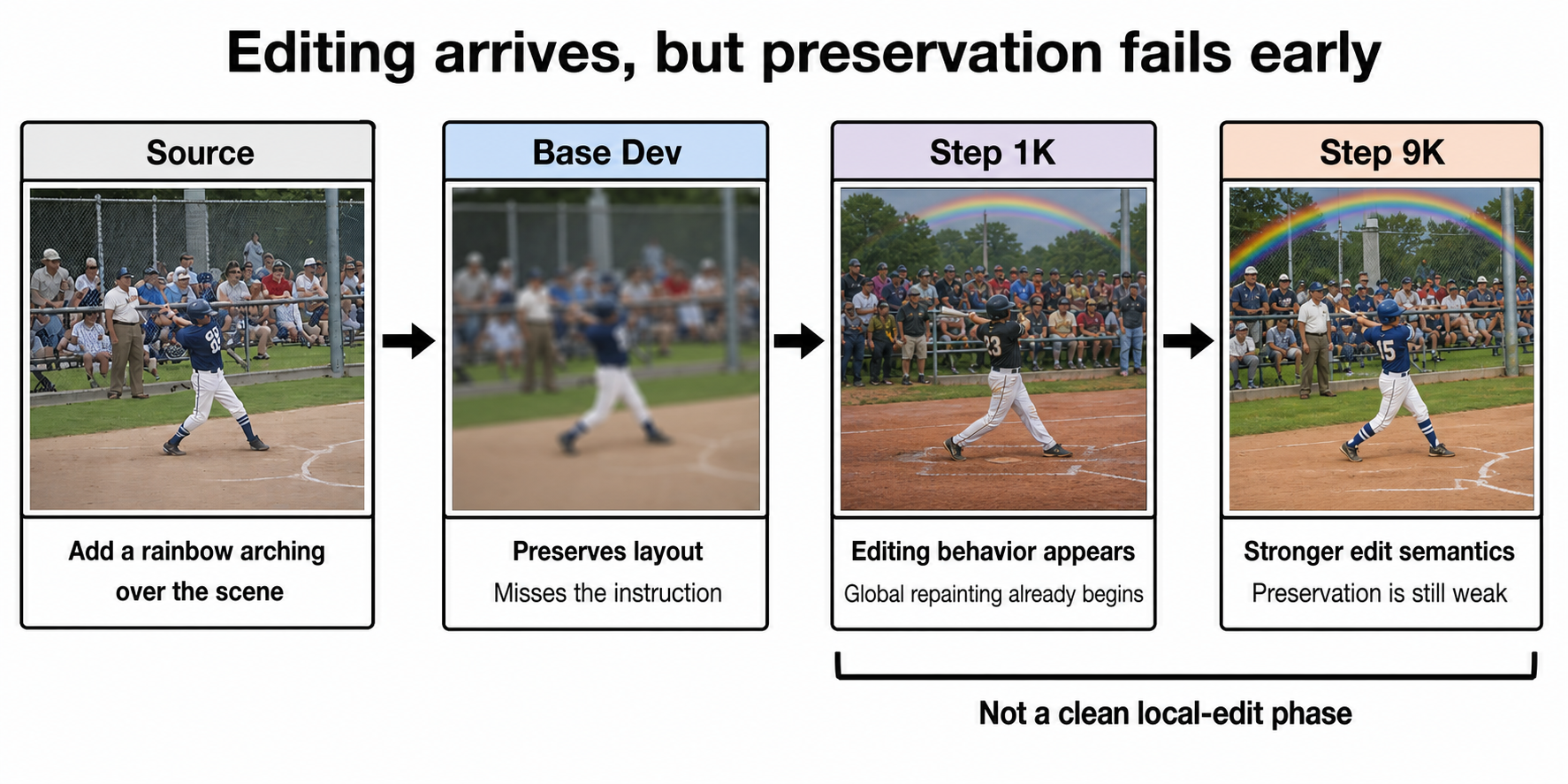
Figure 3. There was no clean early checkpoint that edited gently and preserved everything else. Editing and global repainting arrived together.
Later checkpoints strengthened the requested concept, but preservation did not degrade in a simple curve. The model entered a global-regeneration regime early, then improved semantic control inside it. Target-latent loss could not distinguish a correct local edit from a broadly repainted image that resembled the target.
I repeated the same 9K recipe from the final LongCat-Image text-to-image checkpoint while keeping data, seed, training settings, and evaluation fixed. Its loss curve and visual behavior were effectively the same, so initialization was not the missing preservation mechanism.
A Data-Centric Intervention
The LongCat report emphasizes source-target structural alignment, while GPT-Image-Edit treats identity preservation separately from instruction following. I therefore scored all 100,008 UltraEdit pairs with DINOv2-base similarity and a 64 × 64 pixel mean absolute difference. Within each category, I removed the bottom 5% pixel-MAD pairs as potential near-noops, then selected the 1,000 highest-DINO remaining pairs.
Only 848 examples, or 9.4%, overlapped the unfiltered baseline. The held-out manifest and every other training setting stayed fixed.
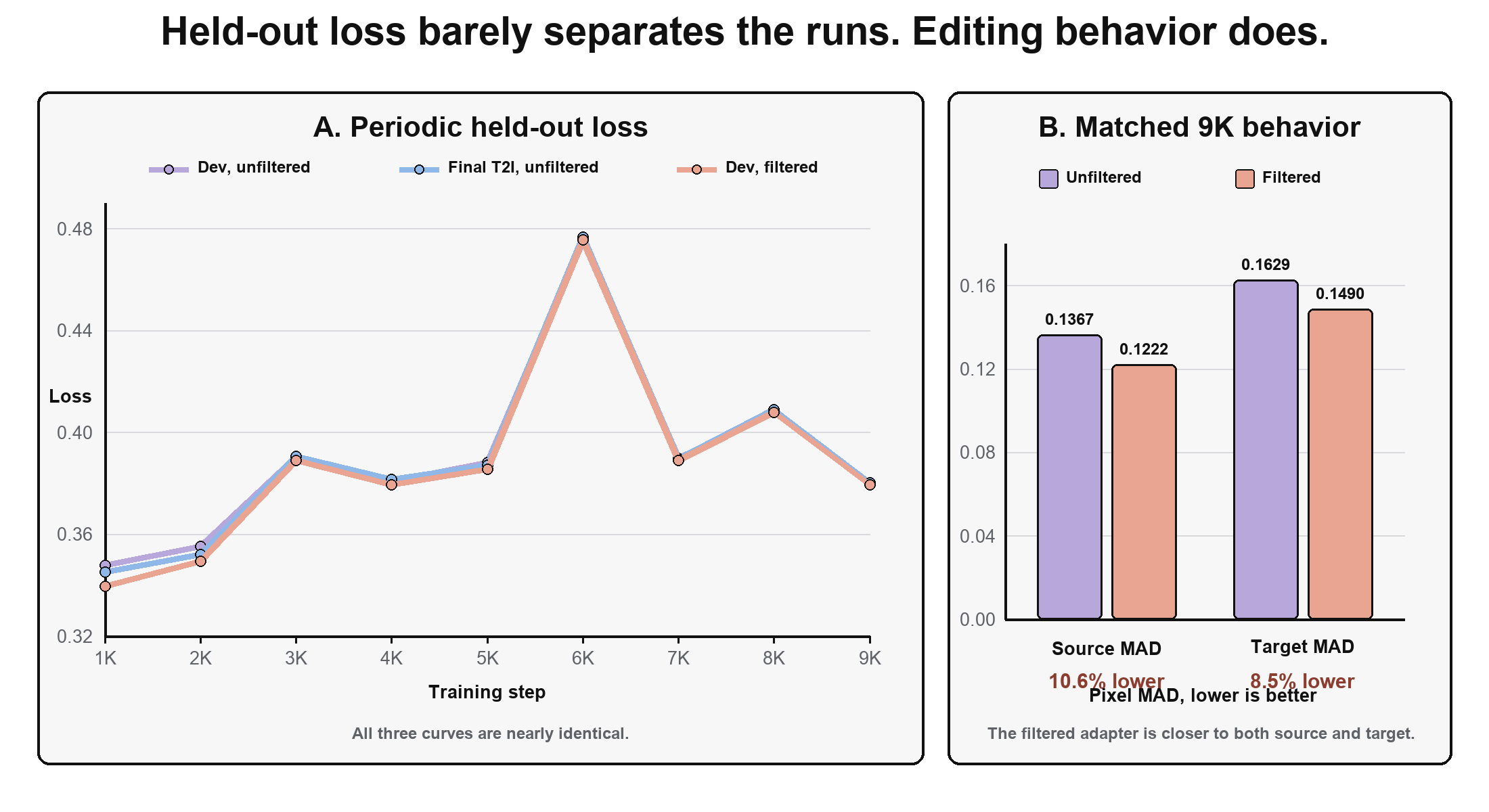
Figure 4. The ordinary held-out loss curves barely separate the runs, while the matched images reveal a meaningful behavioral difference.
At step 9K, the preservation-filtered adapter lowered mean source MAD by 10.6% and mean target MAD by 8.5% against the unfiltered baseline. Fifteen of 18 matched cases were closer to the source, and 16 of 18 were closer to the target.
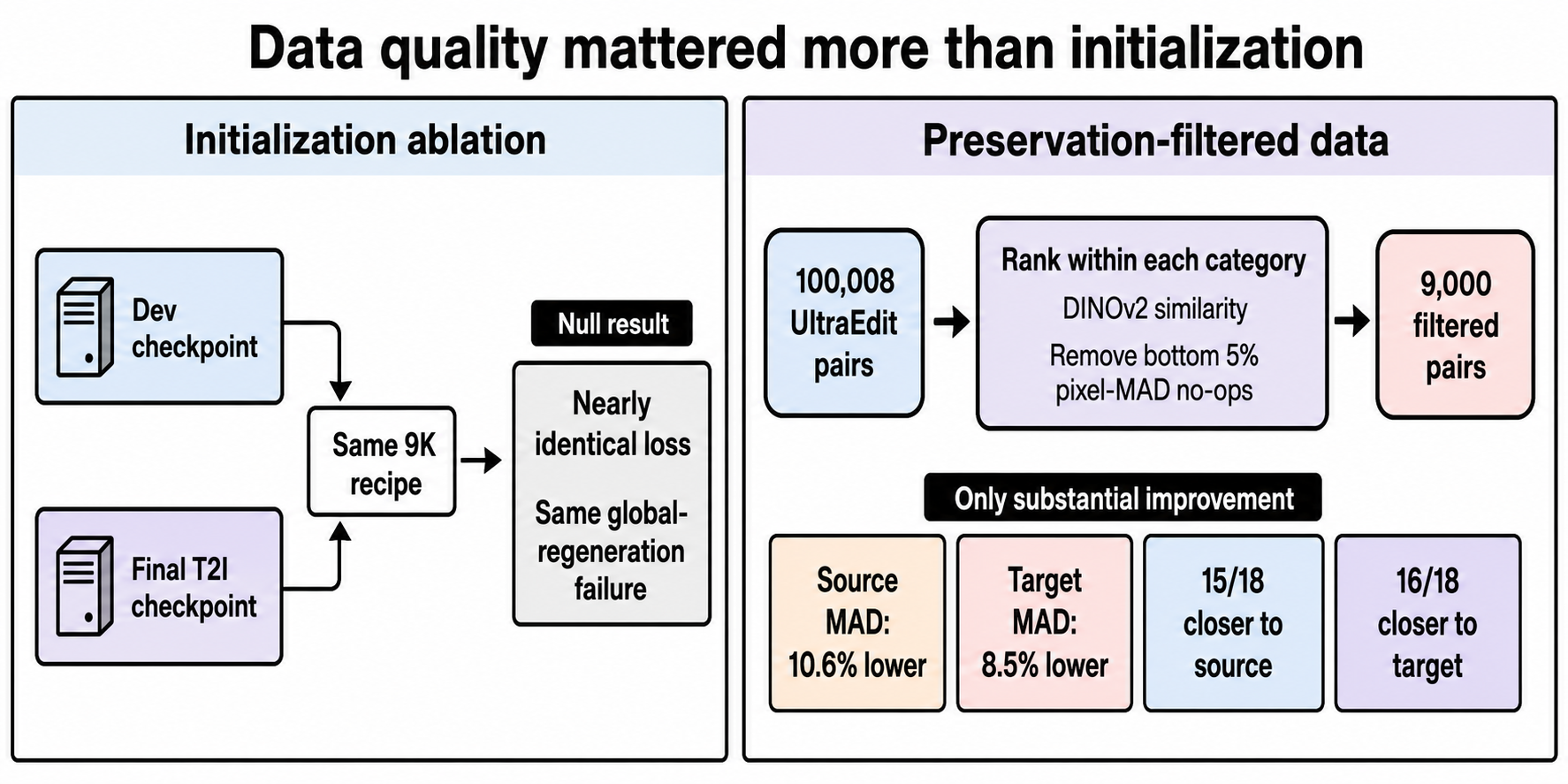
Figure 5. Changing the initializer did not materially change the failure mode. Changing which examples the adapter learned from did.
What the Model Can and Cannot Do
I ran a fresh reload of the final preservation-filtered adapter while writing this post.
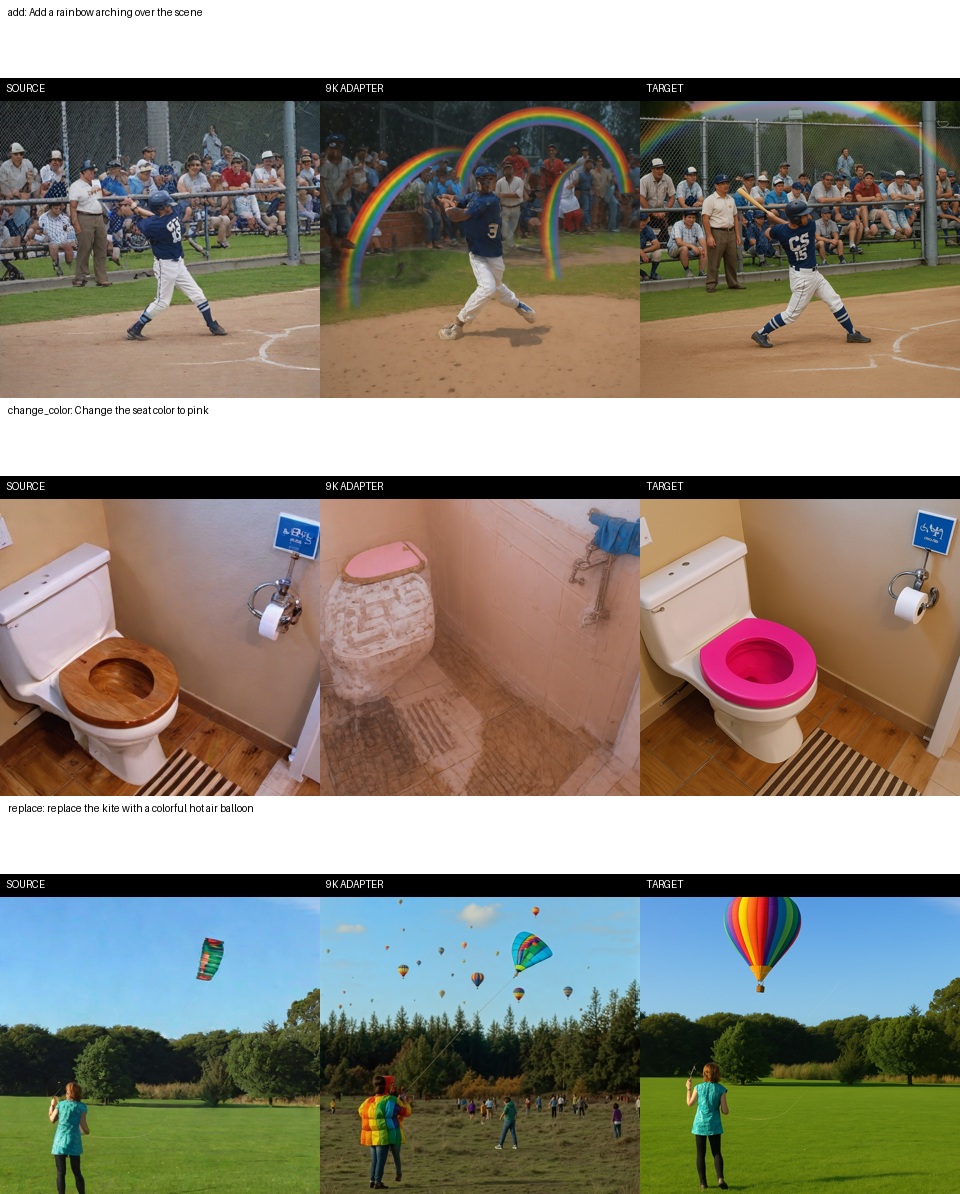
Figure 6. A fresh three-category inference check at 30 steps. The adapter follows some instructions, but successful preservation and precise editing are still inconsistent.
The rainbow example follows the instruction but changes the baseball player's pose. The pink-seat example keeps more of the bathroom layout but does not reach the requested target color cleanly. The kite replacement becomes a broader balloon scene instead of a precise one-object substitution.
This is not a solved image editor. The matched evaluation has only 18 cases, pixel MAD is only a regeneration diagnostic, and I used one seed and one LoRA recipe. Better local editing may require localized supervision, an explicit preservation mechanism, broader parameter updates, or a much larger filtered curriculum.
What I Learned
The result is narrower than saying that more data made the model better. A 47.2M-parameter LoRA taught a text-to-image checkpoint genuine source-conditioned instruction semantics. Switching to the final text-to-image checkpoint did not fix preservation. Selecting more structurally consistent training pairs, with compute and data scale fixed, produced the only substantial improvement.
For my first image-generation research project, the biggest lesson was that image editing is not just instruction following. The unchanged pixels are part of the objective too, even when the training loss does not make that obvious.
The complete bounded study cost $58.57 in metered Modal usage before credits. I stopped after the two pre-registered ablations rather than turning it into an open-ended sweep.
References
-
Base model:
LongCat-Image-Dev
on Hugging Face. The 6B mid-training checkpoint used for all runs.
-
“LongCat-Image Technical Report.”
arXiv:2512.07584.
The report describing the checkpoint family and its editor initialization.
-
Official training repository:
meituan-longcat/LongCat-Image
on GitHub. The source-conditioning machinery and training recipe this experiment builds on.
-
“GPT-Image-Edit-1.5M.”
arXiv:2507.21033.
The source of the UltraEdit triplets used for fine-tuning.
-
Training data:
UCSC-VLAA/GPT-Image-Edit-1.5M
on Hugging Face.

This is my first research experiment in image generation. I wanted to find out whether a small adapter could teach an open-weight text-to-image checkpoint to edit a source image from a natural-language instruction. The model had to follow the requested change while preserving everything else. Adding the right object while repainting the entire scene would not count as reliable editing.
Figure 1. The bounded question behind the project: can a rank-32 LoRA teach source-conditioned editing to a mid-training text-to-image checkpoint?
Why I Picked LongCat-Image-Dev
I used LongCat-Image-Dev, a 6B-parameter development checkpoint released by the Meituan LongCat team in late 2025. Dev is a mid-training, comparatively plastic state intended for downstream SFT, LoRA, and specialized Edit training. Their technical report also initializes the full LongCat editor from the mid-training text-to-image model rather than its final post-trained checkpoint.
I was not reproducing the full LongCat-Image-Edit recipe. My experiment kept the official source-conditioning machinery, updated only a LoRA adapter, and asked what could be learned from 9,000 balanced edit pairs.
The Zero-Shot Gate
Before training, I constructed the Edit pipeline using only Dev components. With the source, seed, resolution, guidance, and sampling steps fixed, I asked it to replace a cat, add red sunglasses, and recolor a gray sofa. All three outputs reconstructed the original cat and sofa without meaningfully following the instructions.
Figure 2. Architectural compatibility was not the same as editing ability. Dev accepted source-image conditioning, but editing behavior still had to be learned.
This was a useful failure. The source-conditioning pipeline executed end to end, but any later editing behavior would have to come from fine-tuning.
Training the Adapter
I used the UltraEdit portion of GPT-Image-Edit-1.5M, pinned to 100,008 validated source, target, and instruction triplets across nine edit categories. The serious baseline sampled 1,000 training pairs and 100 held-out pairs per category, then trained once over 9,000 examples at 512 pixels on an NVIDIA H100.
The recipe used a rank-32 LoRA on attention and feed-forward projections, BF16, a learning rate of
1e-4, 100 warmup steps, gradient checkpointing, and flow matching. Only 47,185,920 parameters were trainable. Noisy target latents were concatenated with source latents, and Qwen2.5-VL saw both the source image and instruction.After an 18-example smoke test and a 2,250-example pilot, the 9K run completed in about 66 minutes, produced nine resumable checkpoints, and reloaded the final adapter successfully.
Editing Appeared, but So Did Global Regeneration
The adapter clearly learned something the base checkpoint did not have. Rainbows, balloons, recolors, snow, and requested objects began appearing. The important surprise was when they appeared: the checkpoint study showed broad scene changes by step 1,000, not only after prolonged training.
Figure 3. There was no clean early checkpoint that edited gently and preserved everything else. Editing and global repainting arrived together.
Later checkpoints strengthened the requested concept, but preservation did not degrade in a simple curve. The model entered a global-regeneration regime early, then improved semantic control inside it. Target-latent loss could not distinguish a correct local edit from a broadly repainted image that resembled the target.
I repeated the same 9K recipe from the final LongCat-Image text-to-image checkpoint while keeping data, seed, training settings, and evaluation fixed. Its loss curve and visual behavior were effectively the same, so initialization was not the missing preservation mechanism.
A Data-Centric Intervention
The LongCat report emphasizes source-target structural alignment, while GPT-Image-Edit treats identity preservation separately from instruction following. I therefore scored all 100,008 UltraEdit pairs with DINOv2-base similarity and a 64 × 64 pixel mean absolute difference. Within each category, I removed the bottom 5% pixel-MAD pairs as potential near-noops, then selected the 1,000 highest-DINO remaining pairs.
Only 848 examples, or 9.4%, overlapped the unfiltered baseline. The held-out manifest and every other training setting stayed fixed.
Figure 4. The ordinary held-out loss curves barely separate the runs, while the matched images reveal a meaningful behavioral difference.
At step 9K, the preservation-filtered adapter lowered mean source MAD by 10.6% and mean target MAD by 8.5% against the unfiltered baseline. Fifteen of 18 matched cases were closer to the source, and 16 of 18 were closer to the target.
Figure 5. Changing the initializer did not materially change the failure mode. Changing which examples the adapter learned from did.
What the Model Can and Cannot Do
I ran a fresh reload of the final preservation-filtered adapter while writing this post.
Figure 6. A fresh three-category inference check at 30 steps. The adapter follows some instructions, but successful preservation and precise editing are still inconsistent.
The rainbow example follows the instruction but changes the baseball player's pose. The pink-seat example keeps more of the bathroom layout but does not reach the requested target color cleanly. The kite replacement becomes a broader balloon scene instead of a precise one-object substitution.
This is not a solved image editor. The matched evaluation has only 18 cases, pixel MAD is only a regeneration diagnostic, and I used one seed and one LoRA recipe. Better local editing may require localized supervision, an explicit preservation mechanism, broader parameter updates, or a much larger filtered curriculum.
What I Learned
The result is narrower than saying that more data made the model better. A 47.2M-parameter LoRA taught a text-to-image checkpoint genuine source-conditioned instruction semantics. Switching to the final text-to-image checkpoint did not fix preservation. Selecting more structurally consistent training pairs, with compute and data scale fixed, produced the only substantial improvement.
For my first image-generation research project, the biggest lesson was that image editing is not just instruction following. The unchanged pixels are part of the objective too, even when the training loss does not make that obvious.
The complete bounded study cost
$58.57in metered Modal usage before credits. I stopped after the two pre-registered ablations rather than turning it into an open-ended sweep.References